About Tank Wars
A love letter to the classic tank artillery game.
Why this site exists
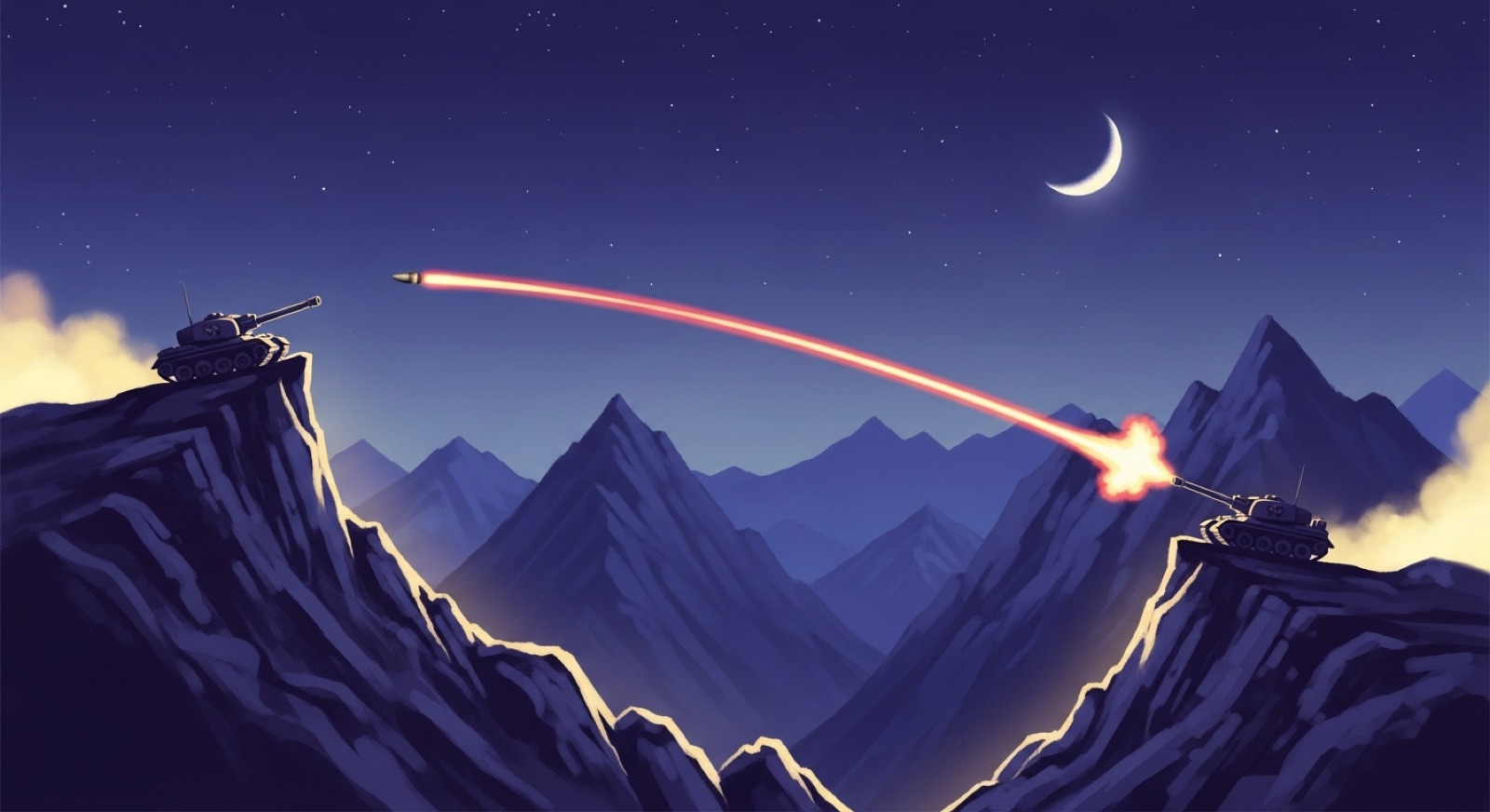
Tank Wars exists because there's a very specific shape of fun that only a tank artillery game delivers: you and a friend, taking turns, nudging an angle one degree, bumping the power slider up by three, and watching a shell arc over a mountain and either land perfectly on their treads or sail forty pixels long. It's slow, it's thoughtful, it's hilarious when wind shifts mid-shot, and there's nothing else quite like it.
For years, the way to scratch that itch was to dig out a copy of Scorched Earth, talk a friend into installing the same version of an emulator, set up a way to take turns, and hope none of the modern operating system's defenses ate the executable. Pocket Tanks works great on a couch with one device, but breaks the moment your friend lives in a different city. Worms is fantastic but very much its own thing.
Tank Wars is the simplest possible version of the format: open the site, type a name, pick a color, get a link, send it to up to three friends. No account, no install, no app store. Take a turn when you feel like it. Forget about the game for a day. Come back, your tank is exactly where you left it, the wind has shifted, your friend has already taken a chunk out of the mountain in front of you. That's the entire pitch.
What we believe
- No accounts, ever. A game URL is the only credential. If you can read the link, you can play.
- Turn-based is a feature, not a limitation. Asynchronous play means the game fits around real life, not the other way around.
- The page should load in under a second on a phone in a basement. Tank Wars is a single static bundle behind nginx — no SPA framework runtime, no tracker zoo, no dark patterns.
- Your data stays small. We store the bare minimum to host a game and nothing else. See the privacy policy for the exact shape of it.
- Free for as long as we can keep it up. One Adsterra banner at the top pays the Cloud Run bill. No upsells, no premium tier, no “watch an ad to skip your wait.”
A short history of the tank artillery game
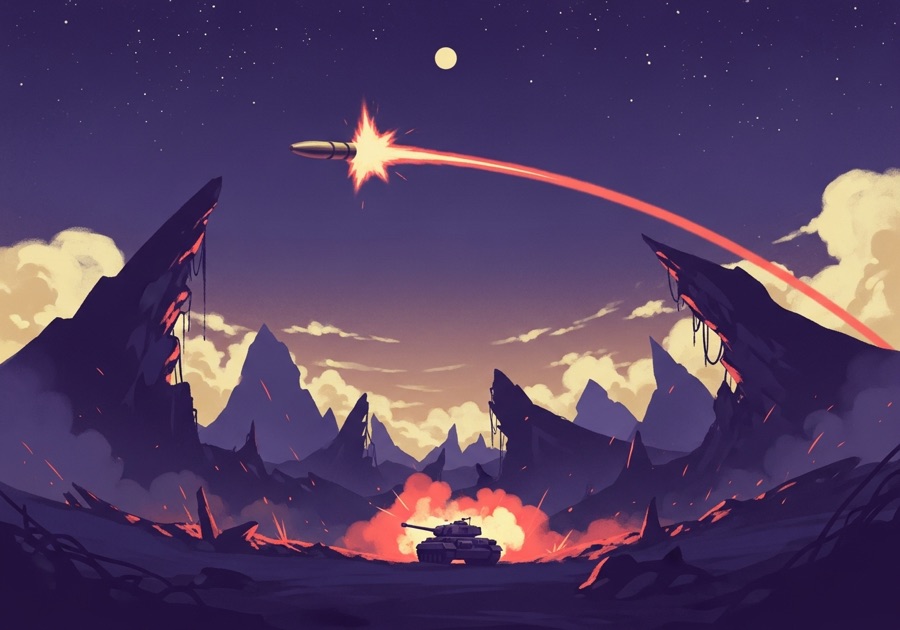
The tank artillery game is older than the personal computer. Its earliest known ancestor is Mike Forman’s “Artillery,” a BASIC program published in Creative Computing magazine in 1976 — two players, a teletype, and a simulated projectile arc computed from gravity and an angle the players took turns typing in. It was revised in 1977 as “War 3” and again in 1979 as “Artillery-3,” a line of code traceable in the genre’s long Wikipedia entry.
What people actually remember, though, is Scorched Earth — Wendell Hicken’s 1991 shareware release for DOS. Scorched Earth had everything: forty-odd weapons, destructible terrain, AI opponents you could mix with humans, and a hot-seat mode that turned every dorm-room PC into a battleground for an afternoon. It is the modern archetype of the format and the direct lineage behind nearly every tank artillery game that followed: Death Tank, Atomic Tanks, Charred Dirt, xscorch, Scorched 3D, and onward.
On the other branch of the family tree, Mike Welch’s Scorched Tanks (Amiga, 1993) inspired his own successor, Pocket Tanks (1995), which has been ported to nearly every platform that has ever shipped a screen and now boasts 325 weapons across its expansion packs. Worms (Team17, 1995) took the genre, gave the tanks legs and accents, and went on to sell tens of millions of copies — but the underlying mechanic, two warring blobs lobbing physics over a destructible landscape, is pure 1976.
Tank Wars sits inside that same lineage. The angle, the power, the wind, the terrain that hollows out under repeated near-misses — we didn’t invent any of it. We just put it back on a URL, the way it always should have been.
Tips for new players
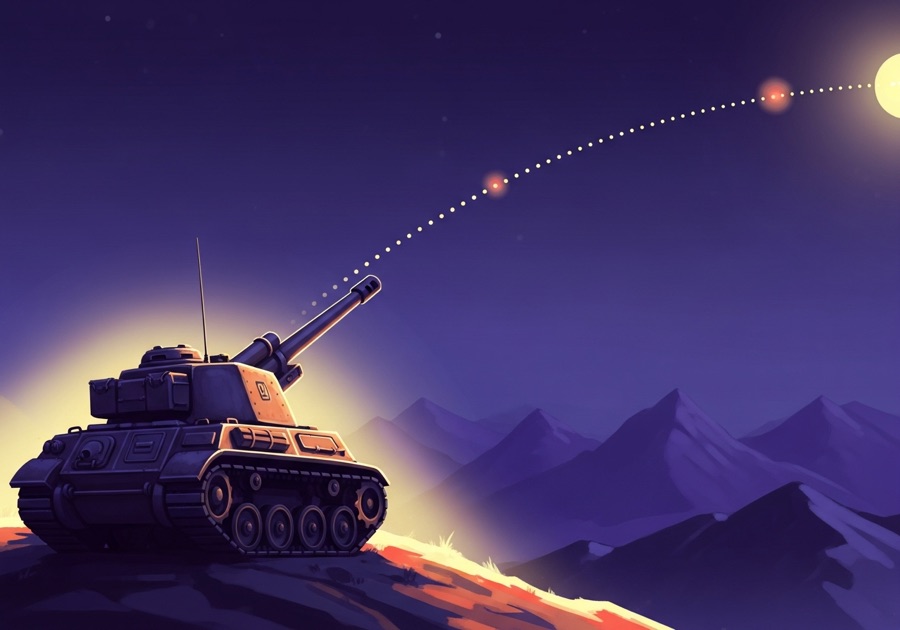
- Mind the wind. A 30 mph crosswind moves a long-range shell more than you’d guess. If you bracketed your last shot, adjust power before angle.
- Use the mountain. A direct line of sight is a luxury. High arcs are slower but harder to read; flat shots are fast but predictable.
- Bracket, then split. Land one shell short and one long, then aim halfway between the two slider values. Old artillery trick, still works.
- Take a chunk out of the terrain. Sometimes the right move isn’t to hit the opponent — it’s to remove the hill protecting them.
- Notifications help. Tap the bell icon on the game page and you’ll know the moment your opponent takes a shot, even when the tab is in the background.
Get in touch
Bug reports, feature ideas, complaints about wind physics, or just a story about the longest game you’ve ever played — email contact@linearmotionjunctionbox.com. A real person reads every message.